KAZALCI OKOLJA

Environmental indicators in Slovenia


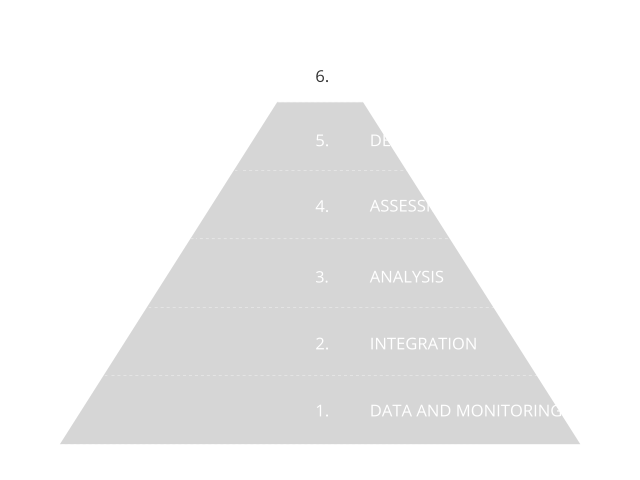
Environmental indicators are based on graphs, maps and assessments and as such present environmental trends in Slovenia. The indicators represent one of the four pillars of our environmental reporting, and are prepared in accordance with the Environmental Protection Act. The Environmental Indicators in Slovenia website enables users to browse among 180 indicators. They are based on numerical data and they indicate the state, characteristics and trends of environmental development in Slovenia. They are prepared using a systematic approach based on data and monitoring, as shown in the information pyramid.

Did you know?

Bad

In Slovenia, the breeding of indigenous domestic animals is becoming less attractive, and out of 15 indigenous breed 14 are endangered. The Carniolan honeybee being the only exception. Thirteen out of 14 traditional breeds are also endangered. The share of introduced animal breeds and crossbreeds with introduced breeds has been increasing. The breeds and races where the adaptation to natural conditions is the strongest are the most successful with defining the introduced breeds.

Neutral

In Slovenia the concentration of dioxins in human milk is low and comparable to those in the neighboring countries. Long-term surveillance will be possible once regular national human biomonitoring is established and assured.

Bad

In 2011, electricity consumption increased due to some economic growth. In 2000-2011 period, the average consumption growth was 1.7% per annum, which matches the projections in the current NEP.
Compared to the year 2000, the biggest growth was recorded in services sector, followed by the households.

Bad

In 2011 continued the dominance of solid fuels for the production of electricity, which has been available for use in Slovenia, but the share is slowly decreasing. Followed by renewable energy sources to 30% share and of nuclear energy has been produced 24% of electricity. The share of electricity produced from domestic sources was 80% above the target set by the Resolution of the National Energy Program.

Neutral

In the production of electricity and heat in thermal power plants and combined heat and power plants 55% of input energy was lost in the year 2010.
Due to a lack of new investments, the efficiency of electricity production and of electricity and heat production is improving too slowly. Compared to the EU-27, Slovenia produced electricity and heat 4 percentage points less efficiently.

Neutral

Water protection areas represent 17% of the area in Slovenia. Of this 61% is forest, 30% agricultural land, 6% urban land and 3% other surfaces. From agricultural land on the WPA, 49% is grassland, 36% arable land, and permanent crops, agricultural land in afforestation and other agricultural land by 5% each. In the period 2002-2011 have increased the forest areas (1.3%) and urban land (2.3%), and decreased agricultural land (to 1228 ha, or 1.2%).