KAZALCI OKOLJA

Environmental indicators in Slovenia


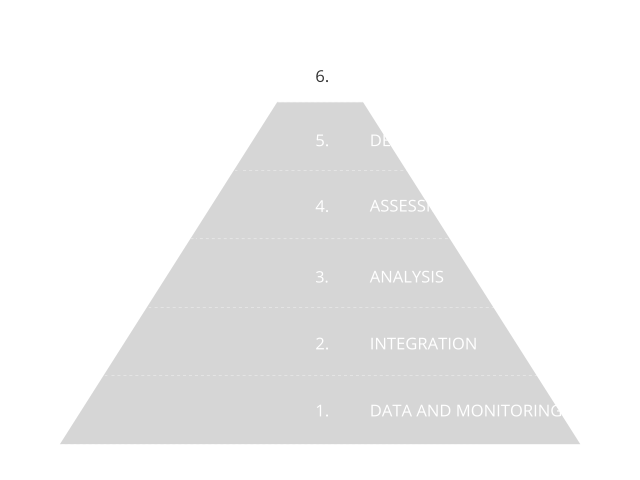
Environmental indicators are based on graphs, maps and assessments and as such present environmental trends in Slovenia. The indicators represent one of the four pillars of our environmental reporting, and are prepared in accordance with the Environmental Protection Act. The Environmental Indicators in Slovenia website enables users to browse among 180 indicators. They are based on numerical data and they indicate the state, characteristics and trends of environmental development in Slovenia. They are prepared using a systematic approach based on data and monitoring, as shown in the information pyramid.

Did you know?

Good

The amount of landfilled biodegradable waste decreased rapidly up to 2013, after which the reduction stopped. In 2016 and 2017, as a result of upgrading the infrastructure for mechanical biological treatment of waste before disposal, the amount decreased significantly again, and in 2018‒2020 it was almost zero. In the period 2016–2020 the amount was significantly lower than the target in 2020. The main measures to achieve this reduction are separate collection of waste and mechanical biological treatment of mixed municipal waste.

Good

Concentrations of total arsenic in blood, urine and breast milk in Slovenia are low and comparable to concentrations worldwide.

Long-term surveillance will be possible once regular national human biomonitoring is established.

Bad

In the last decade (2012–2021), on average around 135,000 tons of hazardous waste was generated annually in Slovenia. This waste accounted for 1% to 3% of all generated waste in Slovenia. Since they contain substances harmful to the environment and health, they must be collected, recovered or disposed of separately from other waste.

In the last decade (2012–2021) each resident of Slovenia annually discards on average around 3.5 kg of hazardous municipal waste, of which the majority in waste electrical and electronic equipment (63%).

Bad

Electricity consumption in households is increasing, especially in the last two years, and in 2021 it amounted to 3,803 GWh. The share of households equipped with goods that require electricity for their operation is also increasing. For example dishwasher, tumble dryer, mobile phone, microwave oven, personal computer as well as heat pump and air conditioner.

Neutral

In Slovenia, in 2020 the external costs estimate of electricity production ranges from 0.8 - 2.8 € c2000 / kWh. Despite growing environmental awareness, the price of electricity still does not reflect all external costs. Due to incorrect price signals, which are the result of the current situation on the electricity markets, energy sources in Slovenia remain suboptimally used.

Good

Slovenia has a fairly high level of energy intensity that is decreasing, especially in the last few years. Average yearly decrease rate in the period 2005-2021 was 2.7 %. Compared to EU-27 Slovenia had 37 % higher intensity in 2020, being 11 % points lower than in 2005.