KAZALCI OKOLJA

Environmental indicators in Slovenia


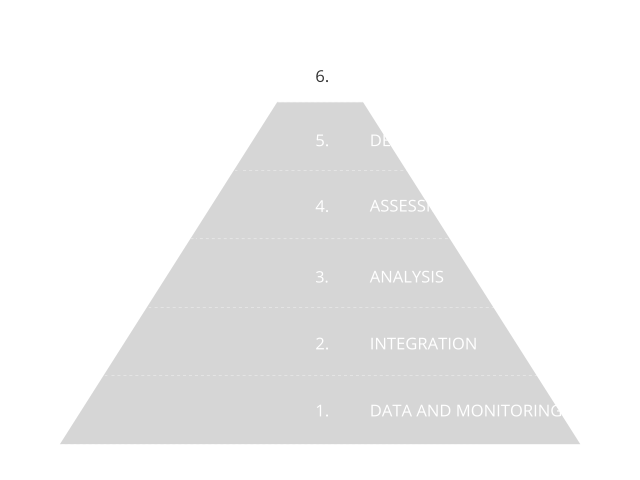
Environmental indicators are based on graphs, maps and assessments and as such present environmental trends in Slovenia. The indicators represent one of the four pillars of our environmental reporting, and are prepared in accordance with the Environmental Protection Act. The Environmental Indicators in Slovenia website enables users to browse among 180 indicators. They are based on numerical data and they indicate the state, characteristics and trends of environmental development in Slovenia. They are prepared using a systematic approach based on data and monitoring, as shown in the information pyramid.

Did you know?

Bad

In 2024, 118,700 m2 of total floor area of public sector buildings were renovated within the cohesion policy programs, and in the period 2021–2024, 548,200 m2 or 60% of the value planned in the Long-term strategy for energy renovation of buildings by 2050. Within the OP EKP 1.08 million m2 of total floor area were renovated by the end of 2024, which is at the level of the OP EKP target value. For the energy renovation of buildings owned and occupied by the central government the gap behind the target from OP EKP was significant.

Bad

With the increasing share of electric passenger vehicles, CO2 emissions decreased in 2022 and 2023, but increased slightly in 2024 compared to the previous year due to the decrease in the share. The gap to the target value is almost 34%.

The average emissions of all passenger vehicles increased in 2022 compared to the previous year. In 2023, the average emissions decreased back to approximately the level of 2021. The target values were not achieved.

Neutral

In 2023, energy efficient district heating (DH) systems, i.e. systems that meet one of the criteria defined in Article 50 of the Act on Energy Efficiency, produced 87,7% of all heat in DO systems, which is the highest value in the observed period. The total share of heat from renewable energy sources (RES) and waste heat amounted to 21,2% in 2023. It increased by 0.5 percentage points compared to the previous year, and by 5.5 percentage points compared to 2016.

Bad

The intensity of GHG emissions from fuels and energy in transport in Slovenia was 4.7% lower than the baseline in 2021, which is 1.3 percentage points below the target reduction. Although the intensity is decreasing, the pace is too slow. The largest contribution to reducing intensity comes from the blending of biofuels. In the EU, the largest reductions were achieved by Sweden and Finland, along with 11 other countries that achieved reductions of 6% or more.

Bad

The share of renewable sources in total energy consumption was 18.4% in 2024. It remained unchanged compared to the previous year. The growth of RES is very slow and insufficient to achieve the targets in this area.

Bad

Slovenia’s import dependence has been lower in recent years, amounting to 48% in 2023. Further increases in energy efficiency, the use of renewable sources, and the diversification of supply sources are essential. Slovenia is completely import-dependent for liquid fuels and natural gas. With regard to natural gas, Slovenia is import-dependent on two countries, Austria and Algeria. In the past, gas reaching Austria mostly came from Russia, but in recent years the supply structure has become more diversified due to the war and sanctions.