KAZALCI OKOLJA

Environmental indicators in Slovenia


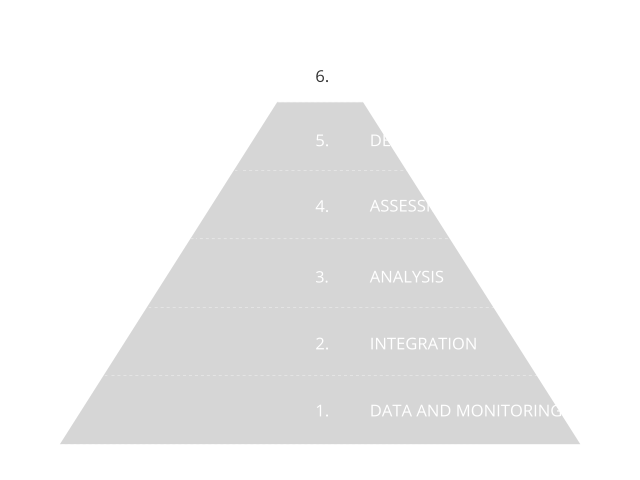
Environmental indicators are based on graphs, maps and assessments and as such present environmental trends in Slovenia. The indicators represent one of the four pillars of our environmental reporting, and are prepared in accordance with the Environmental Protection Act. The Environmental Indicators in Slovenia website enables users to browse among 180 indicators. They are based on numerical data and they indicate the state, characteristics and trends of environmental development in Slovenia. They are prepared using a systematic approach based on data and monitoring, as shown in the information pyramid.

Did you know?

Good

Slovenia has participated in the European Mobility Week (EMW) initiative from the very beginning. Its implementation has become an important form of promotion and encouragement of sustainable mobility planning in the last decade. Since the beginning of the implementation in 2002 165 Slovenian municipalities have participated in the EMW initiative at least once, and 7 municipalities every year. The number of participating municipalities has increased over the years and has already reached almost 80% of Slovenian municipalities.

Neutral

Incentives that go against the goal of reducing greenhouse gas (GHG) emissions have increased again after 2021, primarily due to extensive emergency measures introduced in response to rising energy prices. Excluding these temporary measures, the level of such subsidies in 2023 did not change significantly compared to 2020, with their value increasing by approximately 5.7%.

Neutral

Over the past decade, Slovenia has significantly improved its Eco-Innovation Index, mainly due to the growth in scientific publications, but it still remains slightly below the EU average, as the number of patents and exports of environmental goods and services has declined. Despite this progress, the gap with the EU stood at 4.7% in 2024.

Index includes 12 indicators from five thematic areas. Slovenia is ranked as an average eco-innovation performer. The target value for Slovenia has not been set.

Bad

In 2023, the share of RES in transport, after a significant drop in 2022, increased again and amounted to 10%. With this, it was 0.7 percentage points behind the non-binding 2023 target from the National Energy and Climate Plan (NECP).

Good

From 2012 to 2023, the installed capacity of the systems for the production of electricity from RES has increased by 78,5%. Almost two-thirds of that increase, 51,2%, was achieved in the last four years. The indicator is currently on a trajectory of achieving the indicative targets until 2030 set in the National Energy and Climate Plan (NECP).

Bad

With the increasing share of electric passenger vehicles, CO2 emissions decreased in 2022 and 2023, but increased slightly in 2024 compared to the previous year due to the decrease in the share. The gap to the target value is almost 34%.

The average emissions of all passenger vehicles increased in 2022 compared to the previous year. In 2023, the average emissions decreased back to approximately the level of 2021. The target values were not achieved.