KAZALCI OKOLJA

Environmental indicators in Slovenia


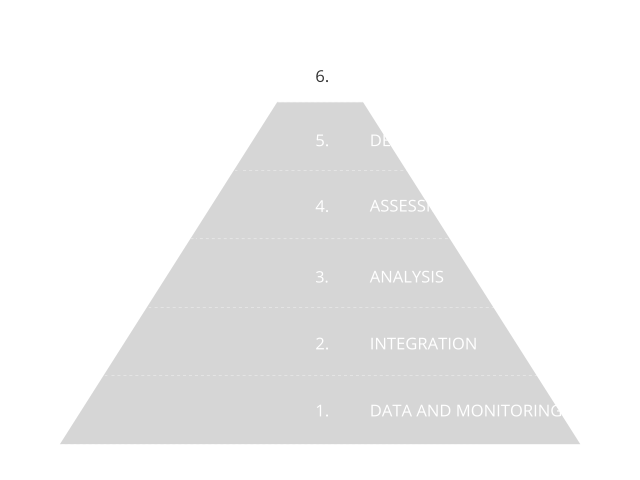
Environmental indicators are based on graphs, maps and assessments and as such present environmental trends in Slovenia. The indicators represent one of the four pillars of our environmental reporting, and are prepared in accordance with the Environmental Protection Act. The Environmental Indicators in Slovenia website enables users to browse among 180 indicators. They are based on numerical data and they indicate the state, characteristics and trends of environmental development in Slovenia. They are prepared using a systematic approach based on data and monitoring, as shown in the information pyramid.

Did you know?

Bad

With the increasing share of electric passenger vehicles, CO2 emissions decreased in 2022 and 2023, but increased slightly in 2024 compared to the previous year due to the decrease in the share. The gap to the target value is almost 34%.

The average emissions of all passenger vehicles increased in 2022 compared to the previous year. In 2023, the average emissions decreased back to approximately the level of 2021. The target values were not achieved.

Good

The quantity of end-of-life tyres collected for recovery increased dramatically when producer liability was introduced. Arround 16,000 tonnes of end-of-life tyres is produced, which is about 8kg per capita. In 2015, 65% of end-of-life-tyres have been recovered through material recovery and 35% through energy recovery.

Neutral

Measurements of particle number concentration of ultrafine particles in ambient air in Ljubljana in period May 2012 -April 2014 is comparable to concentrations in other four European cities. Exposure to ultra-fine particles in the indoor air is roughly comparable or even slightly higher than exposure to ultra-fine particles in ambient air.

Neutral

Population exposure to allergens has been increasing not only in Slovenia but also worldwide. This phenomenon is influenced by the increase in average air temperature. Higher average air temperature results in a longer growing season and thus the longer presence of allergenic pollen in the air. Particularly noteworthy is to mention the pollen of alder, birch, grasses and ambrosia. The severity of exposure to the allergen pollen of alder, birch, grasses and ambrosia shows large annual fluctuations, with distinct differences between the continental Slovenia and the littoral area.

Good
Air

Concentrations of sulphur dioxide in ambient air are no longer harmful for human health. Also, the critical annual value for the protection of vegetation is no longer exceeded. The improvement of the situation in the last decade is a result of the use of low-sulphur fuels in industry and the operation of desulphurisation facilities in thermal power plants.

Neutral

Higher levels of heavy metals and nitrogen are observed around the urbanized areas, industrial regions and around thermal power plants. The reason for elevated levels at the western part of Slovenia is transboundary transport of air pollutants from the Po Valley in Italy, however at the eastern part might be transit traffic and agricultural activity. A decrease of heavy metals and nitrogen in mosses is observed in Slovenia since 1995.