KAZALCI OKOLJA

Environmental indicators in Slovenia


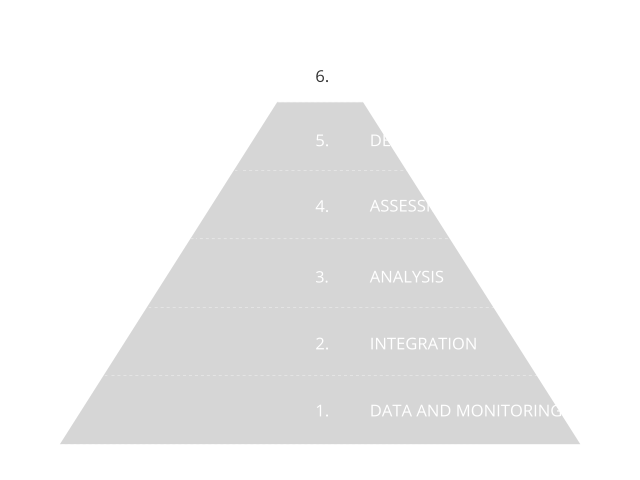
Environmental indicators are based on graphs, maps and assessments and as such present environmental trends in Slovenia. The indicators represent one of the four pillars of our environmental reporting, and are prepared in accordance with the Environmental Protection Act. The Environmental Indicators in Slovenia website enables users to browse among 180 indicators. They are based on numerical data and they indicate the state, characteristics and trends of environmental development in Slovenia. They are prepared using a systematic approach based on data and monitoring, as shown in the information pyramid.

Did you know?

Bad

The share of renewable energy sources (RES) in the use of fuels in industry amounted to 12,8% in 2023, which was 3.6 percentage points behind the annual indicative target value. The 2023 indicative target was thus not achieved. In order to achieve the target of 30% of RES in the use of fuels in industry in 2030, the share of RES will have to increase by 18 percentage points or by about approximately 3 percentage points per year.

Neutral

Almost half of households in single-family houses are in favor of heating with a heat pump. The index was 44 on a scale of 0 to 100 in 2022 and has not changed significantly since 2019. The majority of households in single-family houses still consider the use of renewable energy sources to be important. The share of households considering replacing or supplementing heating with a heat pump, as well as those already using it, increased significantly between 2015 and 2017, and then stabilized. The favorability of heat pumps varies between regions.

Good

Households willingness to use photovoltaic systems in single-family homes has increased. The index increased by 7 index points between 2019 and 2022, reaching a value of 36 on a scale from 0 to 100 in 2022. The share of households that already use or intend to use photovoltaics in the near future has increased the most during this period. Despite the positive change, as many as a quarter of households are still hesitant or reluctant to use photovoltaics. There are no differences in willingness to use photovoltaics between regions.

Bad

Frequency of groundwater drought is increasing in recent decades in alluvial aquifers. 8 out of 10 years with highest intensity of groundwater drought in period 1981-2024 occurred after year 2000. Groundwater droughts with higher intensity is characteristic for winter while milder groundwater droughts mostly occur at autumn. Groundwater drought intensity is also increasing seasonally with time between June and September when groundwater use is pronounced.

Bad

In Slovenia and in other European countries the proportion of vehicle fleet that comply with the latest and most stringent emission standards increased sharply in period 2011-2020. Penetration of new technology is highest for the diesel cars.

Bad

The ownership of passenger cars, closely linked to their usage, has been steadily increasing in Slovenia for a long time – it has doubled since the country's independence in 1991. Between 2008 and 2015, car ownership grew more slowly due to the economic recession, but since 2015, the growth has accelerated again. The exceptions were the pandemic years of 2020 and 2021. Slovenia's motorization rate (measured in the number of personal cars per thousand inhabitants) exceeds the EU average and is higher than that of many economically more developed EU countries.