KAZALCI OKOLJA

Environmental indicators in Slovenia


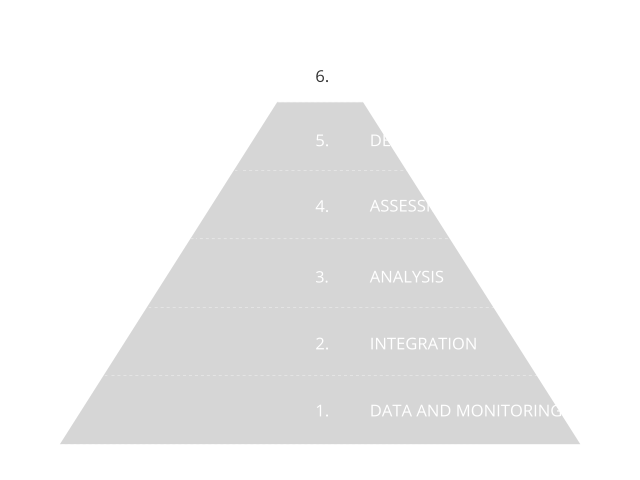
Environmental indicators are based on graphs, maps and assessments and as such present environmental trends in Slovenia. The indicators represent one of the four pillars of our environmental reporting, and are prepared in accordance with the Environmental Protection Act. The Environmental Indicators in Slovenia website enables users to browse among 180 indicators. They are based on numerical data and they indicate the state, characteristics and trends of environmental development in Slovenia. They are prepared using a systematic approach based on data and monitoring, as shown in the information pyramid.

Did you know?

Neutral

The limit value for environmental noise for playgrounds (55dB(A)) determined by the WHO was exceeded at the most exposed facade at 12 primary schools. However none of 34 kindergartens and 22 primary schools was exposed to excess noise limit at all four facades. There were 4,097 pupils in 12 schools and 2,909 children in 24 kindergartens where the high noise levels at most exposed facades were determined in the school year 2013/2014.

Neutral

While the declarative attitude of Slovenian households towards the environment and efficient use of energy is improving, the ratio between environmentally aware and unaware households remains unchanged. This is evident from their environmentally oriented behaviour and actual efficiency in energy use. The results of the Slovenian Energy Efficiency Survey – REUS indicate a great potential for reducing final energy consumption in households through the development of environmentally oriented behaviour and positive habits in energy use.

Good
Sea

Phytoplankton biomass, expressed as chlorophyll a concentration, reflects nutrient loading in the marine environment. Chlorophyll a concentrations shows a trend towards improvement in the status of the Slovenian sea, as the ecological status has been assessed as high or good over the last period.

Good

Deadwood is an important animal and plant habitat that contributes to the biodiversity of forest ecosystems. According to Slovenia Forest Service data, the volume of standing and fallen trees without stumps and branches in 2022 was 21.3 m3/ha, which represented approximately 6% of the entire wood stock of forest stands. In virgin forests, however, the deadwood volume can be even several dozen times greater.

Good

In the past centuries, forest area has been increasing constantly after 2010; however, the rate of expansion has slowed down and remains relatively stable in recent years. Since 1875, when forests covered only 36% of the Slovenian territory, forest cover has increased to 58.5% in the year 2009 and rests stable today at 58.0 %. In terms of forest share, Slovenia ranks third among EU-28 countries, behind Sweden and Finland.

Good

In Slovenia, forests have been growing in terms of growing stock and increment for decades. They have increased by more than 140% over the last 70 years. In addition to natural conditions, harvesting depends on socioeconomic factors, and recently on the occurrence of natural disasters (windbreaks, icebreakers) and bark beetles outbreaks. By 2014, the felling accounted for about 50% of the increment. After the ice storm in 2014, it increased substantially and accounted for 60 to 75% of the total increment of conifers and deciduous trees.