





[RE17] Household Perspectives on propensity for energy-saving household appliances Index
Key message
The preference index for energy-saving household appliances among Slovenian households is a high 83 (on a scale from 0 to 100), which clearly shows the market is in a mature phase and its potential has been largely realized. This is also reflected in the consumer segmentation: on one hand, we find that nearly a quarter are " Energetic Catalysts" who have already fully upgraded their appliances, while on the other, there is only a smaller group of "Passive" and "Restrained" consumers. Under these conditions, future growth no longer depends on convincing sceptics, but on strategically appealing to the largest segment, the "Aware" (27%). These are consumers who are already convinced of the benefits of energy-saving appliances but simply need a final incentive to replace their remaining, less efficient items and complete the transition to a fully energy-efficient home.
Charts
Survey on Energy Efficiency in Slovenia, Informa Echo d.o.o., 2025 (27. 10. 2025)
| Propensity of households[index points (0-100)] | |
|---|---|
| 2025 | 83 |
Survey on Energy Efficiency in Slovenia, Informa Echo d.o.o., 2025 (27. 10. 2025)
| Passive[%] | Restrained[%] | Aware[%] | Advanced[%] | Energetic Catalysts[%] | |
|---|---|---|---|---|---|
| 2025 | 13 | 21 | 27 | 16 | 23 |
Survey on Energy Efficiency in Slovenia, Informa Echo d.o.o., 2025 (27. 10. 2025)
| energy efficient household appliances are useful mainly because they use less energy[%] | we do not see any significant benefit in energy efficient appliances in our household[%] | refuse to answer[%] | don't know[%] | |
|---|---|---|---|---|
| 2025 | 83 | 11 | 2 | 4 |
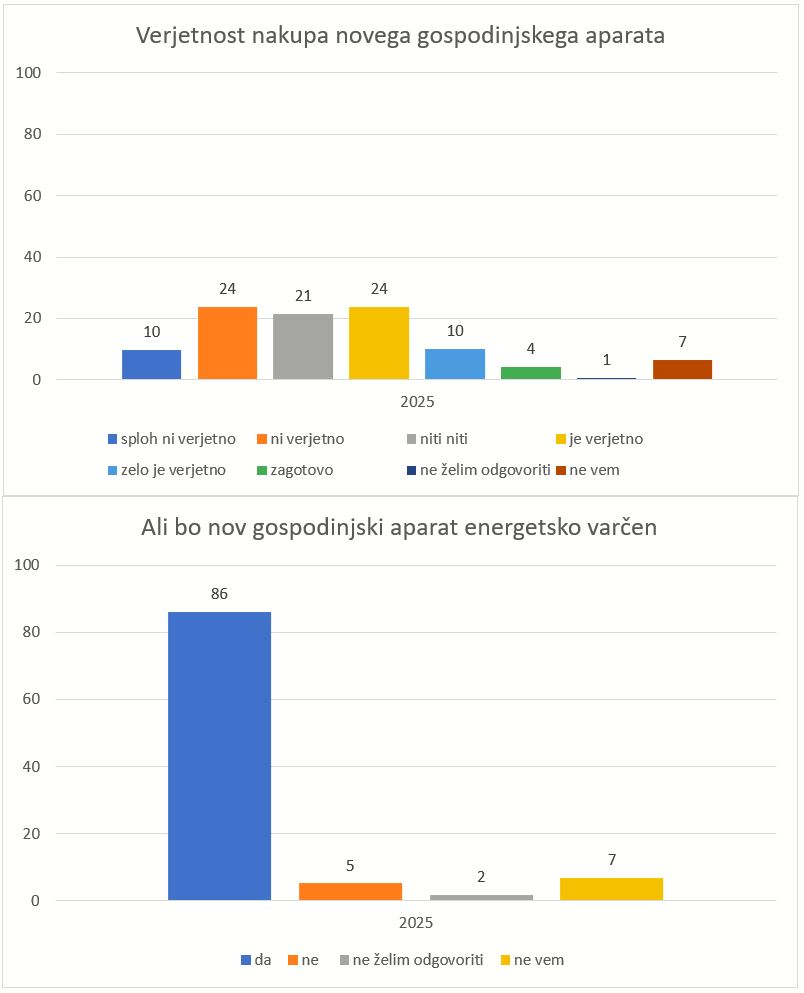
Survey on Energy Efficiency in Slovenia, Informa Echo d.o.o., 2025 (27.10.2025)
Base for the second question: households that are likely, very likely or definitely going to buy a new household appliance.
| Verjetnost nakupa novega gospodinjskega aparata | 2025 |
| sploh ni verjetno | 10 |
| ni verjetno | 24 |
| niti niti | 21 |
| je verjetno | 24 |
| zelo je verjetno | 10 |
| zagotovo | 4 |
| ne želim odgovoriti | 1 |
| ne vem | 7 |
| Ali bo nov gospodinjski aparat energetsko varčen | 2025 |
| da | 86 |
| ne | 5 |
| ne želim odgovoriti | 2 |
| ne vem | 7 |
Survey on Energy Efficiency in Slovenia, Informa Echo d.o.o., 2025 (27. 10. 2025)
| all appliances are energy efficient[%] | most appliances are energy efficient[%] | half of appliances are energy efficient[%] | a quarter of appliances are energy efficient[%] | none of the appliances are energy efficient[%] | refuse to answer[%] | don't know[%] | |
|---|---|---|---|---|---|---|---|
| 2025 | 23 | 43.10 | 18.20 | 7 | 2.10 | 1.20 | 6.30 |
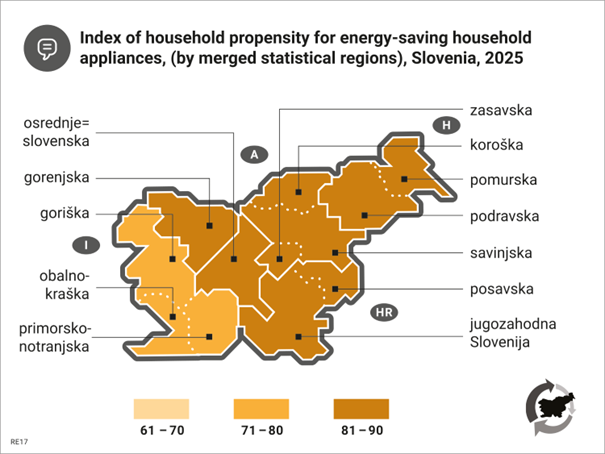
Survey on Energy Efficiency in Slovenia, Informa Echo d.o.o., 2025 (27. 10. 2025)
Due to the small sample size the information for specific regions have been merged. The merged regions in the attached regions map are separated by a dotted line.
| Pomurska, Podravska[index points (0-100)] | Koroška, Savinjska, Zasavska[index points (0-100)] | Posavska, Jugovzhodna Slovenija[index points (0-100)] | Osrednjeslovenska[index points (0-100)] | Gorenjska[index points (0-100)] | Primorsko-notranjska, Obalno-kraška, Goriška[index points (0-100)] | |
|---|---|---|---|---|---|---|
| 2025 | 82.85 | 85.46 | 88.40 | 80.68 | 86.75 | 79.46 |