





[RE03] Public awareness on climate change impacts 
Key message
Although the majority of Slovenian households (69%) still consider climate change a serious problem, the REUS 2025 survey reveals a worrying and consistent negative trend: awareness of the problem's seriousness, the urgency of action, and the role of humans is noticeably decreasing compared to previous years.The share of those who consider the problem "very serious" is the lowest to date. Even more telling is the fact that the share of households who believe the problem is "not serious" has quadrupled since 2022 (from 3% to 12%). Support for the statement that immediate action is necessary has dropped by a significant 18 percentage points since 2015. Likewise, agreement that climate change is primarily caused by human activity has decreased by 17 percentage points.An increasing number of households see industry as the main culprit for emissions (the share increased by 10 percentage points compared to 2015, to 42%), while the perceived responsibility of transport is decreasing, despite it being the second-largest source.In conclusion, while basic awareness is still present, the sense of urgency and personal responsibility is diminishing, and the share of those who deny the problem or shift responsibility to other sectors is growing.
Charts
Survey on Energy Efficiency in Slovenia, Informa Echo d.o.o., 2025 (12. 11. 2025)
| A very serious problem (7-10)[%] | A fairly serious problem (5-6)[%] | Not a serious problem (1-4)[%] | I do not know, n/a[%] | |
|---|---|---|---|---|
| 2015 | 73 | 20 | 6 | 1 |
| 2017 | 79 | 14 | 6 | 1 |
| 2019 | 77 | 12 | 6 | 5 |
| 2022 | 82 | 9 | 3 | 7 |
| 2025 | 69 | 17 | 12 | 3 |
Survey on Energy Efficiency in Slovenia, Informa Echo d.o.o., 2025 (12. 11. 2025)
| I do not know, n/a[%] | Agree[%] | Neither agree nor disagree[%] | Disagree[%] | |
|---|---|---|---|---|
| The fight against climate changes can have positive effects on the Slovenian economy. | 6.80 | 50.20 | 27.20 | 15.80 |
| Human activity contributes most to climate changes. | 3.40 | 69.10 | 16.50 | 11 |
| Climate changes need to be addressed immediately and we are running out of time. | 3.80 | 68.47 | 15.90 | 11.80 |
| The fight against climate changes and more efficient use of energy can boost the economy and contribute to new jobs in the EU | 5.10 | 55 | 24.30 | 15.50 |
Survey on Energy Efficiency in Slovenia, Informa Echo d.o.o., 2025 (12. 11. 2025)
| 2015[%] | 2019[%] | 2022[%] | 2025[%] | |
|---|---|---|---|---|
| The fight against climate changes can have positive effects on the Slovenian economy. | 60 | 54 | 58 | 50.20 |
| Human activity contributes most to climate changes. | 86 | 78 | 73 | 69.10 |
| Climate changes need to be addressed immediately and we are running out of time. | 86 | 77 | 73 | 68.47 |
| The fight against climate changes and more efficient use of energy can boost the economy and contribute to new jobs in the EU | 70 | 67 | 63 | 55 |
Survey on Energy Efficiency in Slovenia, Informa Echo d.o.o., 2025 (12. 11. 2025)
| 2015[%] | 2019[%] | 2022[%] | 2025[%] | |
|---|---|---|---|---|
| Industry | 32 | 32 | 43.10 | 41.83 |
| Transport | 45 | 30 | 16.92 | 23.30 |
| Waste | 5 | 12 | 11.03 | 9.05 |
| Agriculture | 5 | 8 | 8.47 | 7.53 |
| Energy industry | 8 | 8 | 7.58 | 6.31 |
| Households | 1 | 1 | 2.44 | 2.95 |
| Other | 1 | 1 | 1.26 | 1.22 |
| I do not know, n/a | 3 | 8 | 9 | 7 |
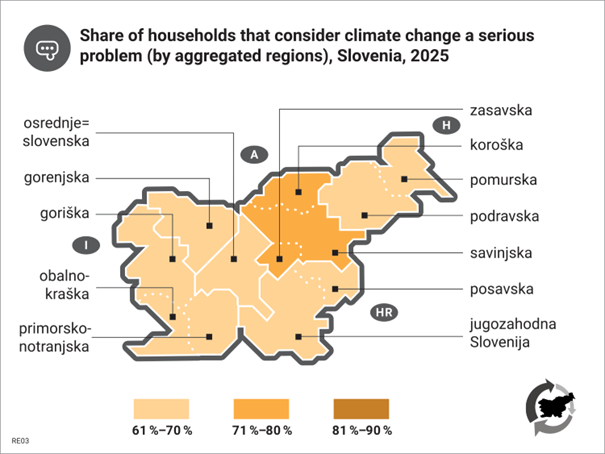
Survey on Energy Efficiency in Slovenia, Informa Echo d.o.o., 2025 (12. 11. 2025)
Due to the small sample size the information for specific regions have been merged. The merged regions in the attached regions map are separated by a dotted line.
| Pomurska, Podravska[%] | Koroška, Savinjska, Zasavska[%] | Posavska, Jugovzhodna Slovenija[%] | Osrednjeslovenska[%] | Gorenjska[%] | Primorsko-notranjska, Obalno-kraška, Goriška[%] | |
|---|---|---|---|---|---|---|
| 2025 | 66.86 | 73.84 | 59.56 | 70.40 | 69.48 | 68.11 |