





[RE04] Public attitude towards sustainable transport
Key message
The results of the REUS 2025 survey show that the willingness of Slovenian households to use alternative means of transport is increasing. Despite this, the personal car remains the absolutely dominant form of transport, and its use over shorter distances is even strengthening. The main reason for this is undoubtedly the large gap between users' wishes and the actual quality of public transport. The main reasons for not using public transport remain the same as in the past: poor connections, being too time-consuming, and inadequate schedules. People do not use it because it is inaccessible and impractical. Despite the obstacles, the willingness to replace the car with public transport has more than doubled since 2011 (from 14% to 37%). The bicycle is also becoming an increasingly desirable alternative. As an incentive for change, households prioritize practical solutions (good connections, speed), while the environmental aspect is losing importance (the share fell from 20% to 14%). In conclusion, there is a large and growing potential for a transition to more sustainable forms of mobility, but this potential remains untapped due to long-standing, unresolved problems in public transport infrastructure and services.
Charts
Survey on Energy Efficiency in Slovenia, Informa Echo d.o.o., 2025 (12. 11. 2025)
The analysis of the results must take into account that in 2019 and 2022 the respondents could only choose one option, whereas in past surveys (2010-2017) they could choose several options at a time.
| car (< 5 km)[%] | car (5-150 km)[%] | bicycle (< 5 km)[%] | bicycle (5-150 km)[%] | walking (< 5 km)[%] | walking (5-150 km)[%] | public passanger transport (< 5 km)[%] | public passanger transport (5-150 km)[%] | |
|---|---|---|---|---|---|---|---|---|
| 2010 | 75 | 93 | 10 | 0 | 19 | 2 | 6 | 4 |
| 2011 | 69 | 91 | 14 | 3 | 29 | 3 | 11 | 8 |
| 2012 | 72 | 93 | 15 | 3 | 20 | 1 | 8 | 7 |
| 2015 | 74 | 89 | 27 | 9 | 36 | 8 | 28 | 24 |
| 2017 | 79 | 90 | 30 | 10 | 33 | 6 | 28 | 22 |
| 2019 | 35.33 | 65.64 | 10.98 | 1.20 | 6.01 | 0.26 | 4.10 | 5.70 |
| 2022 | 43.69 | 70.25 | 9.44 | 0.78 | 6.67 | 0.46 | 6 | 7 |
| 2025 | 41.21 | 69.45 | 11.59 | 0.60 | 7.71 | 0.27 | 11 | 11 |
Survey on Energy Efficiency in Slovenia, Informa Echo d.o.o., 2025 (12. 11. 2025)
The analysis of the results must take into account that from 2019 the respondents could only choose one option, whereas in past surveys (2010-2017) they could choose several options at a time.
| car[%] | bicycle[%] | walking[%] | public passanger transport[%] | |
|---|---|---|---|---|
| 2010 | 87 | 6 | 7 | 17 |
| 2011 | 87 | 11 | 13 | 21 |
| 2012 | 86 | 7 | 8 | 20 |
| 2015 | 87 | 15 | 14 | 30 |
| 2017 | 92 | 24 | 22 | 23 |
| 2019 | 81 | 1 | 1 | 5 |
| 2022 | 80 | 2 | 1 | 8 |
| 2025 | 80 | 1 | 2 | 12 |
Survey on Energy Efficiency in Slovenia, Informa Echo d.o.o., 2025 (12. 11. 2025)
| poor bus connections[%] | unsuitable timetables[%] | takes too long[%] | luggage (easier with car)[%] | bus not available at our location[%] | public transport is not as efficient as abroad and often not on time[%] | the nearest bus stop is too far away[%] | the bus costs more/too much[%] | we use it occasionally[%] | I need the car for my job[%] | out of habit[%] | |
|---|---|---|---|---|---|---|---|---|---|---|---|
| 2015 | 18 | 9 | 9 | 3 | 27 | 0 | 5 | 3 | 7 | 1 | 0 |
| 2017 | 13 | 12 | 12 | 1 | 24 | 0 | 7 | 3 | 5 | 2 | 1 |
| 2019 | 37 | 33 | 32 | 24 | 19 | 15 | 12 | 11 | 11 | 11 | 10 |
| 2022 | 29 | 32 | 31 | 20 | 19 | 14 | 14 | 7 | 5 | 9 | 7 |
| 2025 | 36 | 31 | 33 | 20 | 20 | 20 | 14 | 7 | 8 | 8 | 6 |
Survey on Energy Efficiency in Slovenia, Informa Echo d.o.o., 2025 (12. 11. 2025)
| good connections[%] | so we do not use significantly more time compared to car travel[%] | access to connections[%] | cheaper public transport[%] | to contribute to a cleaner environment[%] | to not reduce the level of comfort[%] | |
|---|---|---|---|---|---|---|
| 2019 | 43 | 45 | 32 | 32 | 20 | 17 |
| 2022 | 42 | 38 | 28 | 26 | 15 | 13 |
| 2025 | 45 | 40 | 30 | 26 | 14 | 13 |
Survey on Energy Efficiency in Slovenia, Informa Echo d.o.o., 2025 (12. 11. 2025)
*Additional answer in 2025.
| walking[%] | bicycle[%] | public passanger transport[%] | car (shared use)*[%] | car (carpooling)*[%] | other[%] | |
|---|---|---|---|---|---|---|
| 2011 | 34 | 16 | 14 | 0 | 0 | 3 |
| 2012 | 24 | 13 | 5 | 0 | 0 | 2 |
| 2015 | 34 | 20 | 12 | 0 | 0 | 5 |
| 2017 | 30 | 19 | 8 | 0 | 0 | 3 |
| 2019 | 21 | 15 | 12 | 0 | 0 | 6 |
| 2022 | 21 | 15 | 16 | 7 | 7 | 9 |
| 2025 | 27 | 21 | 37 | 17 | 16 | 18 |
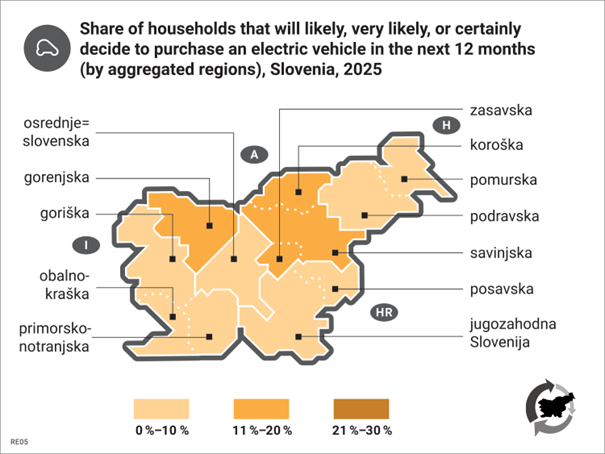
Survey on Energy Efficiency in Slovenia, Informa Echo d.o.o., 2025 (12. 11. 2025)
Due to the small sample size the information for specific regions have been merged. The merged regions in the attached regions map are separated by a dotted line.
| Pomurska, Podravska[%] | Koroška, Savinjska, Zasavska[%] | Posavska, Jugovzhodna Slovenija[%] | Osrednjeslovenska[%] | Gorenjska[%] | Primorsko-notranjska, Obalno-kraška, Goriška regija[%] | |
|---|---|---|---|---|---|---|
| 2025 | 7.91 | 16.52 | 8.28 | 6.39 | 10.86 | 7.05 |