KAZALCI OKOLJA

Environmental indicators in Slovenia


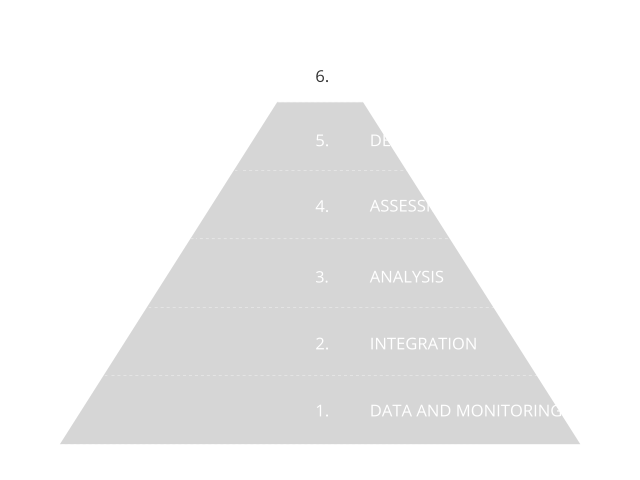
Environmental indicators are based on graphs, maps and assessments and as such present environmental trends in Slovenia. The indicators represent one of the four pillars of our environmental reporting, and are prepared in accordance with the Environmental Protection Act. The Environmental Indicators in Slovenia website enables users to browse among 180 indicators. They are based on numerical data and they indicate the state, characteristics and trends of environmental development in Slovenia. They are prepared using a systematic approach based on data and monitoring, as shown in the information pyramid.

Did you know?

Good

In the period 2005–2022, the land area in the organic farming measure more than doubled (from 20,477 to 50,540 ha). The target set by the Operational Programme for Reducing GHG Emissions until 2020 (OP GHG) for 2020 (44,000 ha) was already exceeded in 2018. The new targets of the Strategic Plan of the Common Agricultural Policy 2023–2027 are significantly more ambitious, and the past trends show that achieving them will be very challenging.

Neutral

In Slovenia, in 2023, monitoring of drinking water quality was carried out for 92.3% of the population, at the point of use (user's tap) on drinking water supply systems, or in 861 supply zones that supplied 50 or more inhabitants and included 25 smaller supply areas, which also supplied public facilities, facilities for the food production. In the drinking water monitoring did not include 7.7% of the population of Slovenia, which supplies fewer than 50 persons e.g. individual supply providing, rainwater.

Neutral

The main source of renewable energy from agriculture in Slovenia is the production of electricity from biogas. Electricity production from "agricultural" biogas plants included in the support scheme for electricity produced from RES increased from 0.04 kToe in 2004 to 10.67 kToe in 2011 and then fell to 5.18 kToe in 2024. The decline in electricity production in recent years is mainly due to the expiration of the right to support, which lasts for 15 years.

Neutral

The total number of varieties listed in the National List of Varieties for cereals, corn, and potatoes has decreased since 2011, while the number of oilseed varieties has steadily increased over the same period, mainly due to domestic varieties registered as conservation varieties and the registration of a larger number of foreign sunflower hybrids. In other crops the number has remained at the similar level. For rye and oats, the proportion of the five most common varieties is 100%.

Bad

In Slovenia, in 2024, 29% of children (0-14 years old) in larger cities were exposed to concentrations of 0-20 µg PM10/m3 and 71 % of children (0-14 years) in larger cities were exposed to concentrations of 20-30 µg PM10/m3. In Europe, most children live in an environment where PM10 concentrations are below 26 µg/m3.

Neutral

The estimated average long-term dietary intake of metals (lead, cadmium, and mercury) for the adult population of Slovenia does not exceed the corresponding reference points (BMDL) or health-based guidance values (tolerable daily/weekly intakes). However, for children, the average intake of lead, cadmium and mercury (fish consumers) may be exceeded, a situation similar to that in the EU.